History
Palo Alto is a city named for a tree. It grew up in the 1890s as the college town beside Stanford University, swallowed the older and rowdier town of Mayfield, and became, through a garage on Addison Avenue and a research park on Page Mill Road, one of the birthplaces of Silicon Valley.

A short history of Palo Alto
Palo Alto is a city named for a tree. It grew up in the 1890s as the college town beside Stanford University, swallowed the older and rowdier town of Mayfield, and became, through a garage on Addison Avenue and a research park on Page Mill Road, one of the birthplaces of Silicon Valley. This page tells that story in short, with a link to the source for every claim. For the full texts of the old books, see the reading list.
The first people and the tall tree
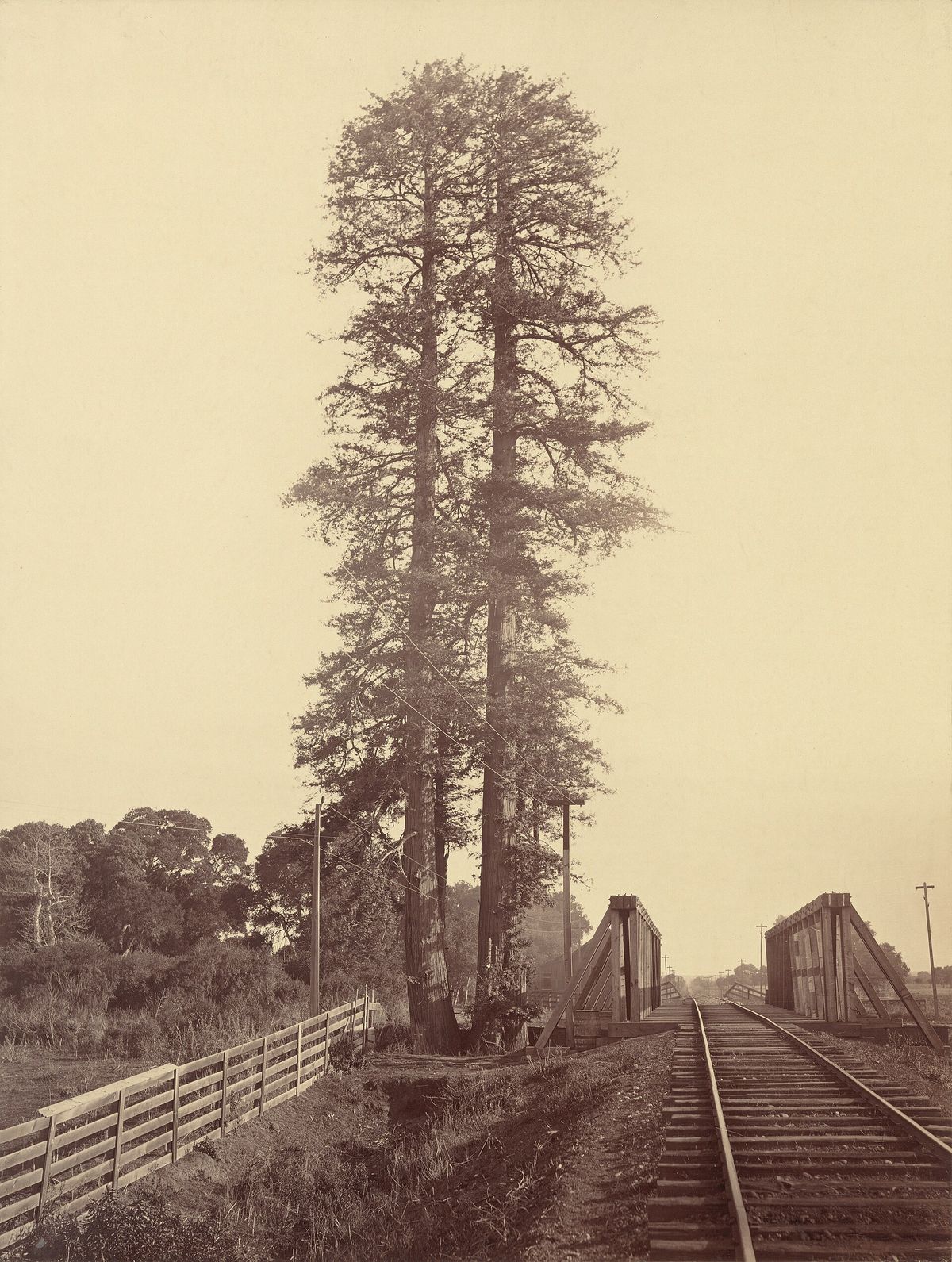
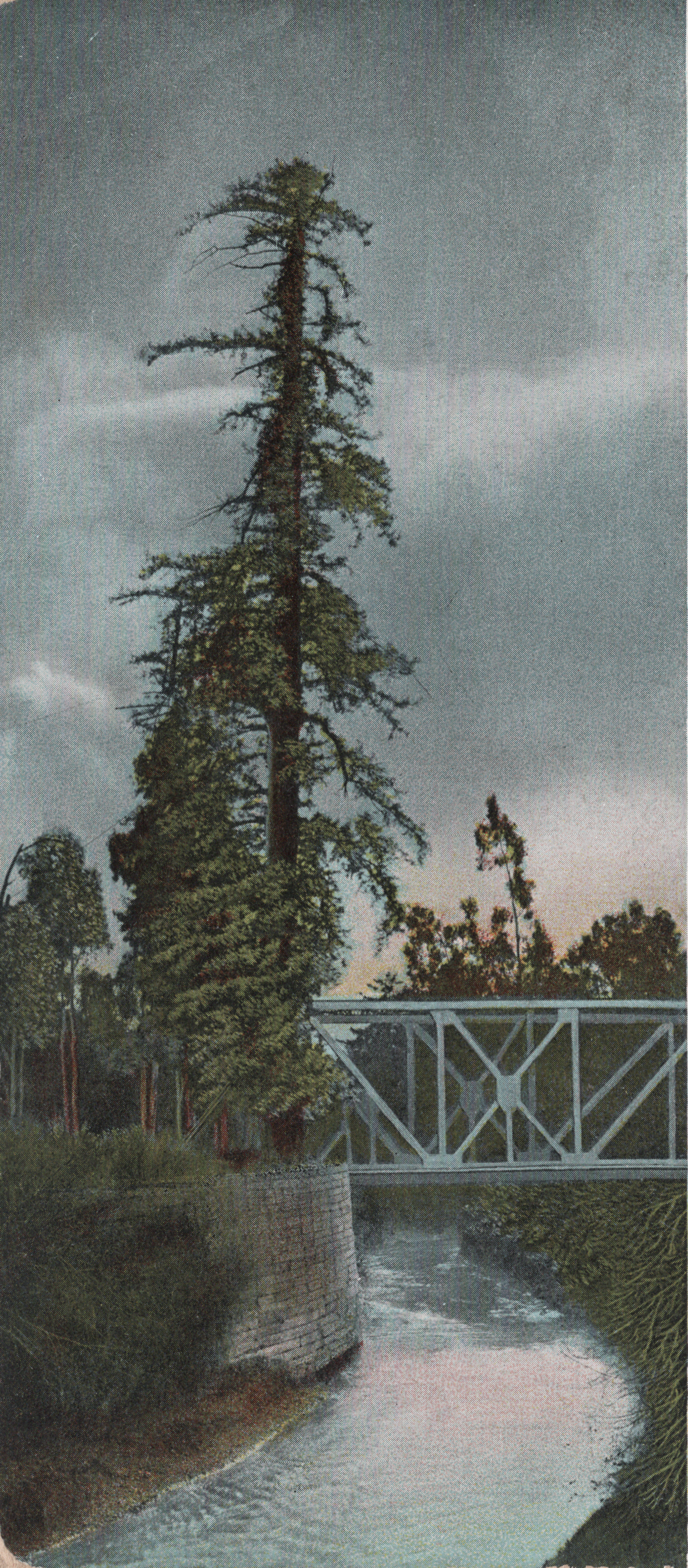
Before Europeans arrived, the Puichon Ohlone lived in the Palo Alto area [1]. The village of Puichon stood near the redwood on San Francisquito Creek that would give the city its name [2]. That tree, El Palo Alto, is a coast redwood thought to have sprouted around the year 940, and it still stands on the creek bank at the city’s northern edge [2].
Portolá’s camp, 1769
In November 1769 the expedition of Gaspar de Portolá, which had marched north from San Diego looking for Monterey Bay and found San Francisco Bay instead, came down to San Francisquito Creek and camped there from November 6 to 11, by a tall redwood later known as El Palo Alto [1]. Tradition holds that the campsite was this very tree, though some historians think it may have been another tree further downstream [2]. In 1776 Juan Bautista de Anza and Father Pedro Font visited the creek and judged its flow too unreliable for a mission [2]. A Spanish diarist described “a tree of immense stature rising above the plain of oaks like a grand tower” [3]. The Spanish first called the trees Palos Colorados, roughly “red trees” [2].
Missions, ranchos and Juana Briones
From 1777 the land was part of Mission Santa Clara, whose northern boundary was San Francisquito Creek [1]. After Mexico won independence the mission lands were granted away as ranchos: Rancho Rinconada del Arroyo de San Francisquito went to Maria Antonia Mesa in 1841, and the Robles brothers bought Rancho Rincon de San Francisquito, which covers about 80% of today’s Palo Alto and Stanford, in 1849 [1]. In 1844 Juana Briones, a Californio rancher, healer and businesswoman, bought the 4,400-acre Rancho La Purísima Concepción, which overlaps today’s Palo Alto and Los Altos Hills [4]. Streets named Miranda and a park and school named for her keep her memory in the city [4].
Mayfield and Uncle Jim’s Cabin
In 1853 Elisha Oscar Crosby bought 250 acres from the Robles brothers and called the place Mayfield Farm [5]. Nearby, James Otterson opened Uncle Jim’s Cabin, a stagecoach stop and saloon near today’s El Camino Real and California Avenue, and a village grew around it [5]. A county history of 1881 says the inn had “a wide reputation in those days,” with travelers pushing their tired horses on to reach it [6]. A post office came in 1855 [6]. Sarah Wallis, who took over Mayfield Farm in 1856, became a leader of California’s women’s suffrage movement, and her home drew visitors such as Susan B. Anthony [5] [15].
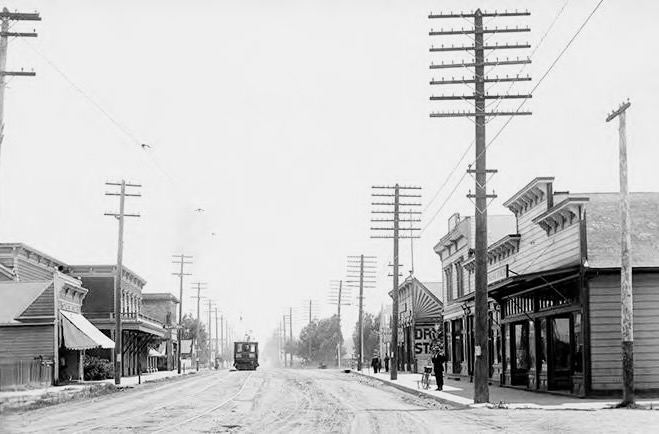
The railroad from San Francisco reached Mayfield in October 1863 [1]. William Paul laid out the town in 1867, with streets named Lincoln, Sherman, Grant, Sheridan and Washington [6]. Mayfield had its own newspaper by 1869, printed in English and Spanish, and it had breweries and, later, a cannery [1].
The Stanfords and the Stock Farm
In 1876 Leland Stanford began buying land along San Francisquito Creek for a horse-breeding farm, the Palo Alto Stock Farm [7]. It grew to about 8,000 acres [2]. There, in 1878 and 1879, the photographer Eadweard Muybridge used a battery of 24 cameras to capture horses in motion, research that led toward the motion picture [8]. In 1875 a Frenchman calling himself Peter Coutts bought land in Mayfield and began a brick tower and an artificial lake in the foothills [9]. He left for France in 1882 without telling his neighbours [33], and Stanford bought his Ayrshire Farm that year [1].
The Stanfords’ only son died in 1884, and they founded a university in his memory on the farm [1]. Stanford University opened on October 1, 1891 [11].
A dry town by the tracks
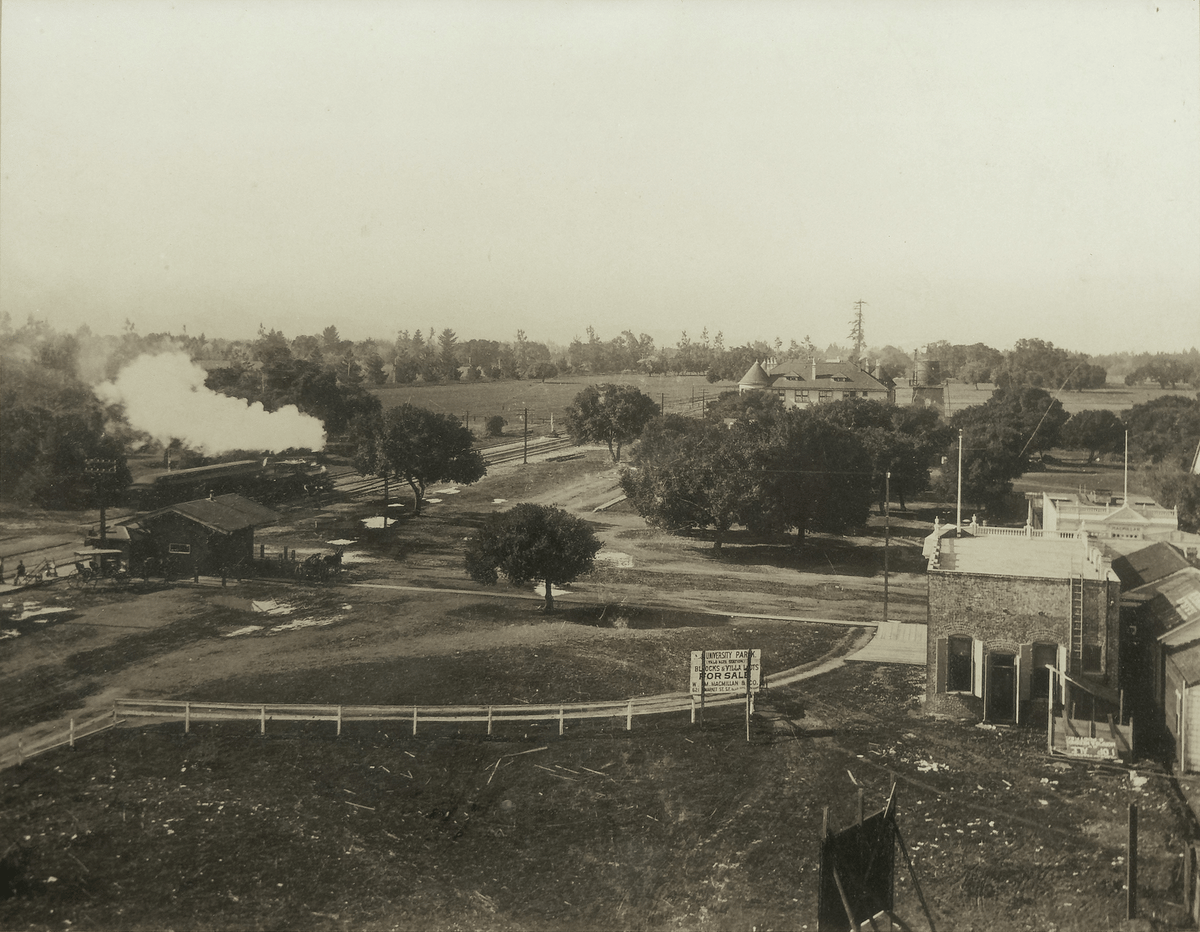
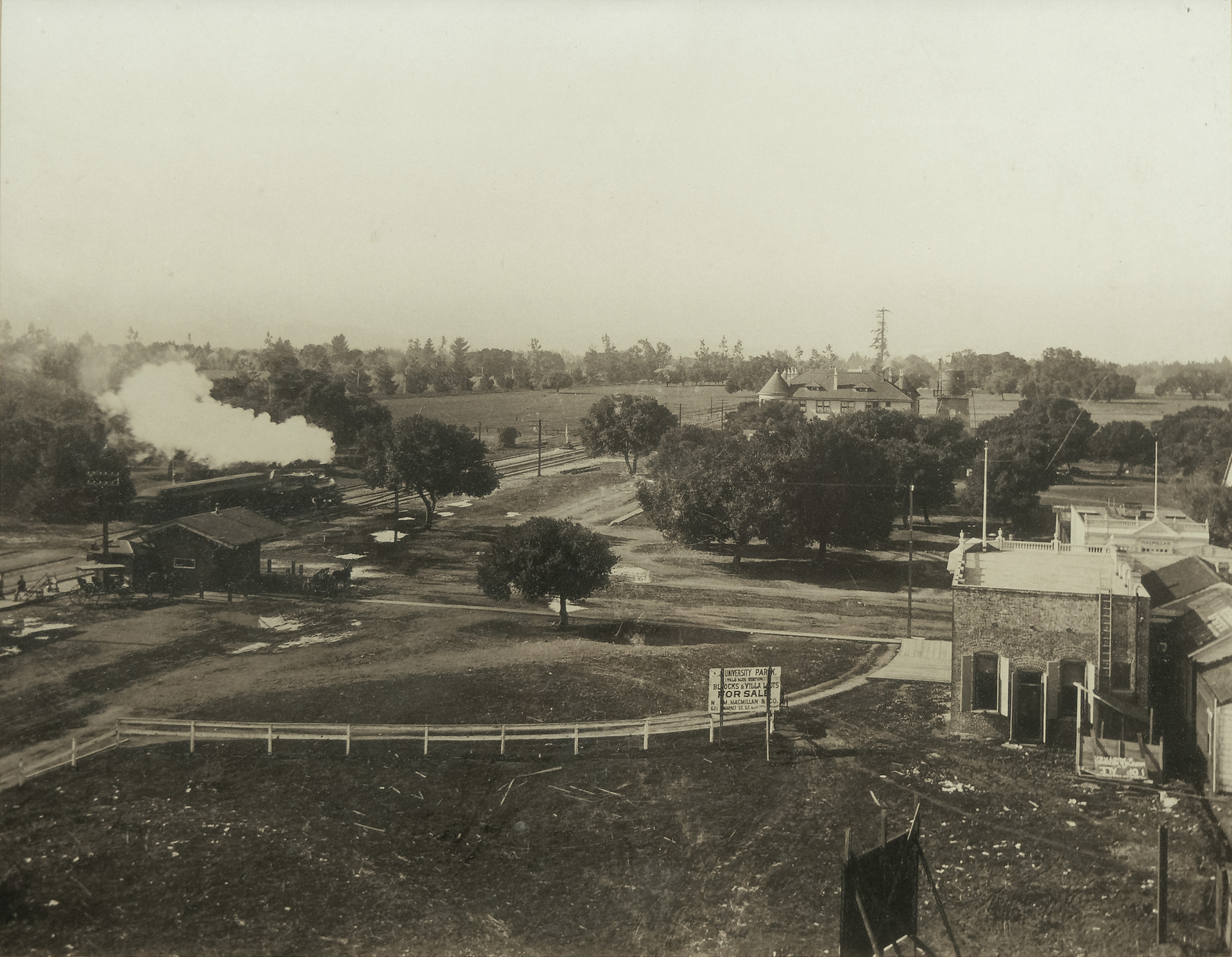
The Stanfords wanted a town at the university’s gate, but on one condition: no alcohol. Mayfield, with its saloons, refused, so the Stanfords’ friend Timothy Hopkins bought 740 acres in 1887 for a new temperance town [1]. Every deed carried a clause forever forbidding the manufacture and sale of liquor [9]. The town was first called University Park, while the name Palo Alto belonged to the tract now called College Terrace, whose developer renamed it at Stanford’s request [1] [14].
When the university opened, Jordan later recalled, “a great wheatfield stretched away to the north, with only a little farmhouse and an old barn in sight” [10]. The first house went up in 1891 and building began in earnest in 1892 [9]. Professors who did not want to lease land from Stanford built just off campus, in the neighbourhood now called Professorville [17]. Palo Alto incorporated on April 16, 1894 [1].
Growing up, 1894 to 1925
The young town built its own water system, electric plant and sewers [11], and it still runs its own utilities today [1]. A 1903 booklet described a town “situated in a grove of live oak trees” and boasted that no saloons were allowed [11]. The Woman’s Club of Palo Alto was founded in 1894, and its circulating library led to the first public library [30]. In 1906 the great earthquake brought down half the town’s chimneys, and about 550 refugees from San Francisco took shelter in Palo Alto [13].
In 1909 Cyril Elwell founded the Federal Telegraph Company in Palo Alto, and there in 1911-13 Lee de Forest built the first vacuum tube amplifier and oscillator, work that led to modern radio and television [16]. By 1922 a county history called Palo Alto “a city of homes” of about 7,000 people [12]. On July 2, 1925, Palo Alto voters approved annexing Mayfield, and the two towns were joined on July 6 [1]. That is why the city has two downtowns, on University Avenue and California Avenue, and two Caltrain stops [1]. The Mayfield News wrote its own obituary [5].
The city that Birge built
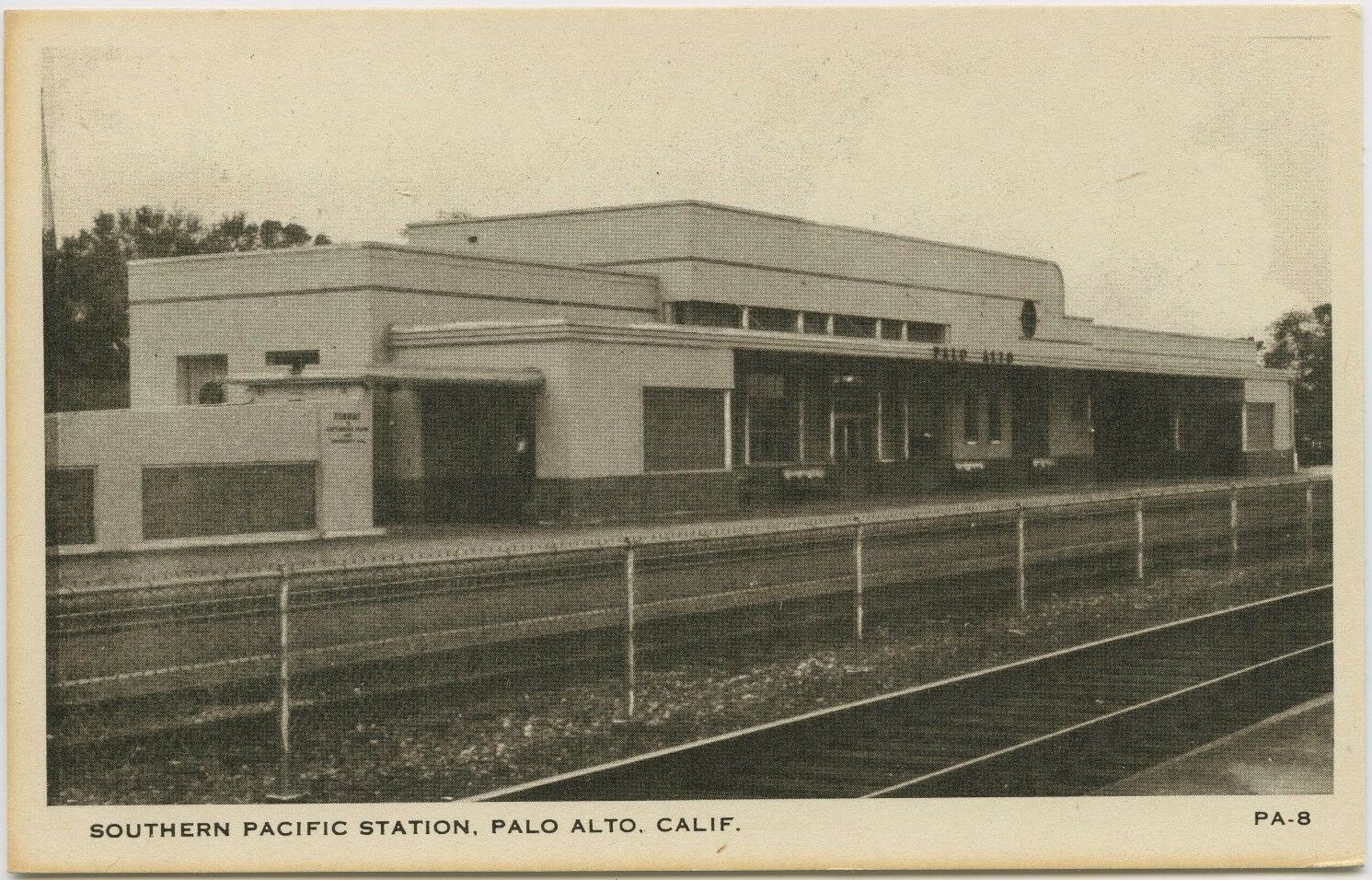
From the 1920s the architect Birge Clark, son of Mayfield’s first mayor, gave much of Palo Alto its Spanish Colonial look, designing the Hotel President, the 1932 post office, the Lucie Stern Community Center and much of Ramona Street [18]. The Stanford Theatre opened on University Avenue on June 9, 1925 [19]. In 1941 Southern Pacific opened a new Streamline Moderne station at the foot of University Avenue [32].
A garage on Addison Avenue
In the 1930s Stanford’s Frederick Terman urged his students to start companies near the university instead of going east [20]. In 1938 two of them, Bill Hewlett and David Packard, began building an audio oscillator in the garage at 367 Addison Avenue, and in 1939 they settled the order of their names with a coin toss [20]. The garage is now California Historical Landmark No. 976, “Birthplace of Silicon Valley” [21].
After the Second World War, Stanford leased land to companies in a new industrial park, begun in 1951; Varian Associates moved in first, in 1953, and Hewlett-Packard set up its headquarters there by 1956 [22]. The Xerox Palo Alto Research Center opened in 1970 and helped invent laser printing, Ethernet and the graphical user interface [23]. Joseph Eichler built almost 3,000 modern homes in Palo Alto, starting with Green Gables in 1950 [1] [31].
Floods, preserves and protests
At Christmas 1955 San Francisquito Creek broke its levees and flooded more than 650 homes [24]. In 1958 Dr. Russel V. Lee offered the city 1,294 acres in the foothills, which became Foothills Park in 1965; it was open only to residents from 1969 until December 17, 2020 [25]. Campaigners such as Lucy Evans and Harriet Mundy fought to save the bay marshes, which are now the 1,940-acre Baylands Nature Preserve [26]. Downtown’s Lytton Plaza, built in 1964, became the town’s traditional place of protest [29]. The last large annexation, Barron Park, came in 1975 [1].
Today
Palo Alto had 68,572 residents at the 2020 census [1]. El Palo Alto still stands by the railroad bridge, smaller than it once was but cared for by the city, and it appears on the city’s logo and on Stanford’s seal [2]. Donkeys have grazed beside Bol Park since 1934 [27], and the rebuilt Junior Museum and Zoo opened in 2021 [28].
Key dates
01
1769
Portolá’s camp
The Portolá expedition camps by a tall redwood on San Francisquito Creek from November 6 to 11. Source ↗
02
1844
Juana Briones’s rancho
Juana Briones buys the 4,400-acre Rancho La Purísima Concepción, on today’s Palo Alto and Los Altos Hills border. Source ↗
03
1853
Mayfield Farm
Elisha Crosby buys 250 acres and names them Mayfield Farm; a village grows around Uncle Jim’s Cabin nearby. Source ↗
04
1863
The railroad arrives
Trains from San Francisco reach Mayfield, at today’s California Avenue station. Source ↗
05
1876
The Stock Farm
Leland Stanford begins buying land for his Palo Alto Stock Farm, where Muybridge later photographs horses in motion. Source ↗
06
1887
A dry townsite
Timothy Hopkins buys 740 acres for a temperance town at the university’s gate. Source ↗
07
1891
Stanford opens
Stanford University opens on October 1, and the first house goes up in the new town. Source ↗
08
1894
A city
The town once called University Park incorporates as Palo Alto on April 16. Source ↗
09
1909
Federal Telegraph
Cyril Elwell founds the Federal Telegraph Company, where Lee de Forest builds the first vacuum tube amplifier in 1911-13. Source ↗
10
1925
Mayfield joins
Palo Alto annexes Mayfield in July, and the Stanford Theatre opens on University Avenue in June. Source ↗
11
1938
The HP garage
Bill Hewlett and David Packard build their first audio oscillator in a garage on Addison Avenue. Source ↗
12
1951
The research park
Stanford’s industrial park, the world’s first university research park, is authorized; Varian moves in first in 1953. Source ↗
13
1965
Foothills Park
Foothills Park opens on land bought from Dr. Russel V. Lee; it becomes residents-only from 1969. Source ↗
14
2020
Open to all
Foothills Park opens to the general public on December 17. Source ↗
Sources
1. Palo Alto, California — Wikipedia
3. El Palo Alto: Rooted in History — Matt Bowling, Palo Alto History
4. Juana Briones de Miranda — Wikipedia
5. Mayfield, California — Wikipedia
6. History of Santa Clara County, California (J. P. Munro-Fraser, 1881) — Internet Archive
7. Palo Alto Stock Farm Horse Barn — Wikipedia
8. California Historical Landmark No. 834: Muybridge Site — NoeHill
9. Stanford University and Thereabouts (O. L. Elliott and O. V. Eaton, 1896) — Internet Archive
10. The Days of a Man (David Starr Jordan, 1922) — Internet Archive
12. History of Santa Clara County, California (Eugene T. Sawyer, 1922) — Internet Archive
13. The 1906 Earthquake — Matt Bowling, Palo Alto History
14. College Terrace, Palo Alto, California — Wikipedia
15. California Historical Landmark No. 969: Homesite of Sarah Wallis Mayfield Farm — NoeHill
16. California Historical Landmark No. 836: Pioneer Electronics Research Laboratory — NoeHill
17. Professorville — Wikipedia
19. Stanford Theatre — Wikipedia
21. California Historical Landmark No. 976: Birthplace of Silicon Valley — NoeHill
22. Stanford Research Park — Wikipedia
23. PARC (company) — Wikipedia
24. The Christmas Flood — Matt Bowling, Palo Alto History
25. Foothills Nature Preserve — Wikipedia
26. Palo Alto Baylands Nature Preserve — Wikipedia
27. Bol Park — City of Palo Alto
28. New Reimagined Palo Alto Junior Museum & Zoo Opens to the Public — City of Palo Alto
29. The Lytton Plaza Protests — Matt Bowling, Palo Alto History
30. Woman’s Club of Palo Alto — Wikipedia
31. Green Gables (Palo Alto, California) — Wikipedia
Further reading
Stanford University and Thereabouts, O. L. Elliott, O. V. Eaton (1896) — public domain, free to read online
Palo Alto: The Town of Leland Stanford Junior University, Palo Alto Board of Trade (1903) — public domain, free to read online
History of Santa Clara County, California, Eugene T. Sawyer (1922) — public domain, free to read online
History of Santa Clara County, California, J. P. Munro-Fraser (1881) — public domain, free to read online
Pen Pictures from the Garden of the World, or Santa Clara County, California, H. S. Foote (editor) (1888) — public domain, free to read online
The Days of a Man: Being Memories of a Naturalist, Teacher, and Minor Prophet of Democracy, David Starr Jordan (1922) — public domain, free to read online
Glimpses of Leland Stanford, Jr., University, Palo Alto, California, J. Collier (publisher) (1902)
Typhoid Fever Epidemic at Palo Alto: A Report, Palo Alto Board of Health (1905)
The Ordinances of the City of Palo Alto, City of Palo Alto (1911)
Stanford Stories: Tales of a Young University, Charles K. Field, Will H. Irwin (1900)
History of Palo Alto: The Early Years, Pamela Gullard, Nancy Lund (1989) — borrow it from the Internet Archive
Palo Alto: A Centennial History, Ward Winslow (1993) — borrow it from the Internet Archive
Palo Alto Remembered: Stories from a City’s Past, Matt Bowling, Betty Gerard (2012) — borrow it from the Internet Archive
Juana Briones of Nineteenth-Century California, Jeanne Farr McDonnell (2008) — borrow it from the Internet Archive
Palo Alto: A History of California, Capitalism, and the World, Malcolm Harris (2023) — borrow it from the Internet Archive
The Philosopher of Palo Alto: Mark Weiser, Xerox PARC, and the Original Internet of Things, John Tinnell (2023) — borrow it from the Internet Archive